Showing posts with label Elephant Orphanage. Show all posts

Sunday, October 15, 2017

Animal and Human Orphans Are Rescued from Despair

Although massive elephants appear to be robust and tough, they are in fact the most fragile of all animals, according to Angela Sheldrick, the dynamic director of the Elephant Orphanage in Nairobi, a sanctuary of hope, part of the David Sheldrick Wildlife Trust, set up in memory of her legendary father.

So when a baby elephant is left alone and stranded in the wilderness when its mother dies from poaching or drought, the helpless infant is desperately vulnerable and terrified. This is a heartbreaking tragedy.

Elephants are just like humans. They have a long life span of 80 or more years and a long childhood of dependency. Babies in the wild suckle from their patient mothers for years and orphans are bottle-fed for up to five years, every three hours around the clock, seven days a week by devoted keepers who even sleep in the stockades to care for the babies through the night.


Orphan eli’s are not ready for release to join the wild herds at Tsavo for 10 years. The orphanage is rescuing one new stranded baby every week because of the devastating drought. That’s a lot of baby elephants to care for over the next decade. People who love elephants can foster an elephant baby on the Trust’s website.

Visitors from around the world to the famous orphanage watch in sheer delight as the adorable babies drink their bottles of milk and then frolic gleefully, slipping and sliding, splashing and thrashing, in the rust-red mud. Angela says wallowing in mud is the equivalent pleasure to humans enjoying a pampering spa!


Meeting Pili

I was lucky to meet the tiniest elephant I’ve every seen, three-week old Pili. His name means ‘pepper’ in Swahili because he was rescued clinging to a pepper tree after falling in the river in the Maasai Mara. Quivering and shy, Pili now sticks close to the larger female baby eli’s, who encircle him protectively. Elephants are so nurturing they will adopt babies from outside their herd and even other species of animals.


Big Cats

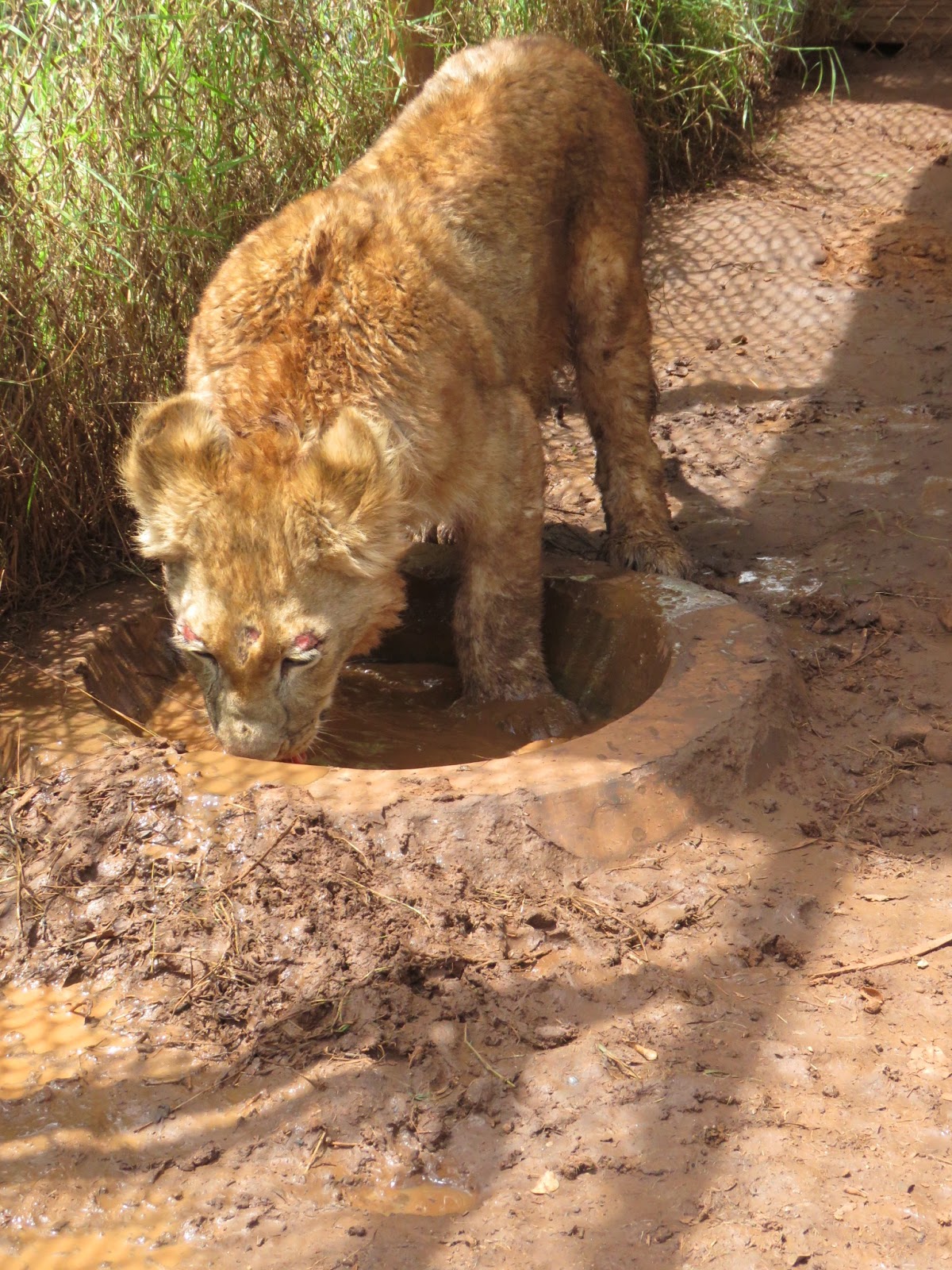
At another Animal Orphanage inside the Nairobi National Park, the rescued babies are mostly big cats. These majestic apex predators are sadly reduced to lazing away their days in enclosures and being handfed chunks of meat, instead of hunting. Rescued as babies, they have been raised in captivity and would be incapable of fending for themselves in the wild.

I discover that lions, unlike elephants, do not care for orphans outside their family group so the ferocious lion and lioness must be kept away from the lonely little cub in separate enclosures or they would kill him.


Seeing these magnificent, powerful animals behind wire mesh, instead of roaming the plains, tugs at my heart but I realise it’s a better alternative than them dying. Most of the big cats have been victims of the drought caused by climate change, which is caused by human pollution. Tragically, the disruption to nature usually leads back to us humans.


Cheating death 

The elegant cheetah with its distinctive streaks under the eyes, is the fastest of all the big cats with their long, greyhound-like legs.

I remember seeing a family of cheetahs relaxing in the shade of a tree on the Maasai Mara last year, looking so proud with disdainful superiority in their ability to reprimand any foolish human with one swipe of a powerful paw.


However baby ‘Derick Duma’ was a sick three-week old cub from Wajir when taken into the orphanage in 2014. The keepers say he cried through months of painful injections, but seemed to know they were helping him to recover. Derek became one of the friendliest cheetahs and loves his animal toys.


Leopards are beautiful with their profusion of spots. Little Talek joined the orphanage in 2006 as a two-week-old cub after being found all alone and crying pitifully near the Maasai Mara. He was hand reared, drinking milk from a bottle, and soon started eating steak mince. Now he is a beautiful, fully-grown leopard affectionate with the keeper who has cared for him since a baby.


Humans Babies without Parents

Sandy McDonald, an eloquent, compassionate woman, living in Melbourne Australia, originally from Zimbabwe, read my stories and contacted me about her own phenomenal charity work in Kenya. Such is the ease of connectivity through social media and the wonders of the worldwide web.

If your heart breaks for animal orphans, the suffering of Africa’s human orphans is beyond comprehension.
Sandy’s research revealed the unimaginable tragedy of one child losing a parent every 22 seconds to HIV-AIDS and the staggering figure of 40 million babies and children abandoned and orphaned across the continent of Africa.

Sandy started the charity, Knit-A-Square with the creative idea of recruiting knitters from around the world to knit squares to sew together to make comforting blankets for orphans. 

Sandy explains: "I came up with the idea and started the website and the community, but the squares went to my Aunt, Ronda Lowrie in South Africa, who agreed to the idea. She was deluged with parcels of hand knitted squares made with tears and love! Aunt Ronda organised the sorting and stitching of over one million squares and items, and the distribution of the blankets to the children over the last nine years.  

"At over 72 now, that is no mean feat.  She is still working tirelessly to do this work supported by the worldwide community."

Sandy launched CreateCare GLOBAL and now supports the Kenyan orphanage, Rafiki Mwema, which cares for and rehabilitates damaged children, who have been the victims of sexual abuse.

Watch Sandy’s enthralling TED Talk and be touched by her passion and astonishing work that has taken off from a humble idea of providing comfort to homeless, parentless desperate children.

For animal and human babies who suffer cruelty, it restores faith in humanity to know that nurturing, protective love is a powerful healing force.

Tuesday, October 3, 2017

The Power To Fly

Something wonderful is taking shape – colourful plans to bring groups of visitors from the UK, Europe, Australia, the US and other developed countries on life-changing trips to Kenya for a combination of volunteering and exciting travel.

I first came across the term “voluntourism” in 2012 when I met an extraordinary man, John Lawler who founded Madventurer– a scheme for students on their gap year - between graduating high school and starting university - to volunteer in challenging projects in developing countries with the opportunity to Make A Difference while having a grand adventure.

John Lawler, a pioneer of voluntourism
I interviewed this modest achiever one sunny day near the Tower of London and was inspired by John's story of starting out with a tiny seed of an idea that grew into the mighty tree of a flourishing worldwide charity.


That summer I did an exciting trip with Madventurer to Ghana as possibly the oldest “gap year” volunteer ever and discovered the joy of making heartwarming connections with people living in another culture!


Coming Alive in Ghana 


Meeting the beautiful children and talented musicians in Ghana on my Madventurer trip in 2012
Voluntourism takes hold 
And here I am five years later in rural Kenya returning to the theme of ‘voluntourism’, excited about the possibility of empowerment and transformation for both visitors and local people.

Millicent and I imagine that international visitors can come and volunteer in the Faraja Community Centre and help with the kids’ activities, the ladies’ sewing project, nutritious cooking classes and planting the community vegetable garden.

Volunteering is certainly NOT about White People flying in as superior, condescending Saviours to tell poor Black People what to do! Oh no, no, no! Volunteering is about an equal, respectful cultural exchange – a sharing of knowledge, creativity and traditions that becomes enriching and expansive for everyone. For example visitors can share their favourite recipes with local women who will share their traditional dishes.

Sweet Bananas

Here’s how respectful, equal friendship works. On Sunday I gave Anne some chocolate to say ‘Asante’ for her delicious meals – a real treat for Anne, who, unlike me, doesn’t get to have much chocolate! Today Anne gave me a perfect bunch of yellow, dainty Lady Finger bananas from her garden – a real treat for me, who relishes good quality, sweet bananas!


I believe people from different cultures can learn much from each other. The cultural exchange adds spice and novelty to bland, jaded lives. And we can make interesting new friends across countries, despite how politicians would divide us and build borders and walls to keep people apart, cultivating ignorance, fear and hostility. The truth is we are all human beings, connected as one big global family – mothers and fathers, brothers and sisters, sons and daughters.

Adventure for All Ages

And what about adventure? Together with Millicent and Garama and their sons, Peter and Eliud, we are devising a range of exhilarating trips to integrate into a three-week stay in rural Kenya.

On arriving in Nairobi, groups will visit the heart-warming Giraffe Centre and Elephant Orphanage before heading upcountry where trips will include game drives to see African wildlife in spectacular Meru National Park staying in the beautiful eco lodge; camping in Mount Kenya National Park , field trips to the remote villages with Millicent, day trips to the nearby tranquil waterfall lagoon, visits to lush hillside coffee and tea plantations and optional extras such as visiting the exotic tribal people, the Maasai Mara  and finally the ultimate add-on for those who are up for experiencing a tropical paradise?

Tongue kissing a giraffe at the Giraffe Centre in Nairobi 

Keepers feeding the babies at the Elephant Orphanage in Nairobi

Brothers, Eliud and Peter at Mount Kenya national Park

A Colobus monkey we spotted on the road to Mount Kenya 

Eco lodge at Meru National Park

Chogoria waterfall

Maasai women on my safari in 2016

George, my new Maasai friend

Peter, a Maasai chief on his smart phone near the Mara River,
teeming with crocodiles

A sleepy lioness spotted by the road on my first game drive on the Maasai Mara

A family of cheetah relax in the shade on the Maasai plains
     

Magnetic Mombasa

When I first saw the word ‘Mombasa’ on the map of Kenya and neighbouring Diani Beach (with my name on it!), I was enchanted by the musical sound of the word as it rolled around my tongue. I quietly vowed to visit. However I never made it to the legendary coastal town on my last trip in 2016.

Mombasa is apparently a laid-back hippy haven of non-stop reggae parties and hot and steamy, glorious beaches, full of beautiful bodies basking in endless sunshine.

Over and over the hypnotic word “Mombasa” keeps cropping up. People whisper about romantic adventures camping under the stars with a view of Mount Kilimanjaro on the way to Mombasa!

And now the long-awaited new train from Nairobi to Mombasa is finally running, taking travellers right through spectacular Tsavo National Park with wild animals roaming free – you can spot buffalo, zebra, giraffes, lions, elephants from the window of the train!

The word ‘Mombasa’ evokes rapturous reactions even in reserved people.
While having lunch - a mountain of masala chips and spanish omelette -  on the balcony overlooking the rainforest at the Snow Peak Hotel, Pastor Garama’s face lights up at the mention of Mombasa! Suddenly he is lost in the revelry of fond memories of the magical town where he grew up with three brothers and three sisters, running free!  

Young Mark, the surgeon I met at the guesthouse, raves about Mombasa as some kind of paradise and warns that once you succumb to Mombasa’s idyllic charms, the danger is you never want to leave!  

Idyllic Mombasa beach that captures the heart and soul of visitors

For the Wild At Heart Only 

For the wild at heart and the eternally youthful, I’m imagining running three trips a year – in the dry months of January/February (a great escape from the bleak English winter); May/June (slightly cooler in Kenya) and the springtime of August/September for groups of nine to 12 people, in age groups of energetic young people aged 20 to 35, mid-lifers, aged 35 – 50 and the adventurous Over 50s. The question is, can you see yourself joining in the life-changing voluntourism movement?


The Power to Fly

The metamorphosis of the lowly caterpillar into a beautiful butterfly is an inspiring symbol of transformation. But have you imagined what it actually FEELS like to be that mundane grub, wriggling along munching through leaves mindlessly, running on instinct, never looking beyond the next leaf, until one day you decide to spin yourself a reclusive cocoon where you retreat to contemplate your life’s higher purpose. While in this dark slumber something miraculous is taking place. You are being transformed! Suddenly you emerge with shock and exhilaration – you are reborn in a different form – with a set of beautiful wings with the power to fly!